Slab Track on American Soil: Auditing the Economics Before the Concrete Pours
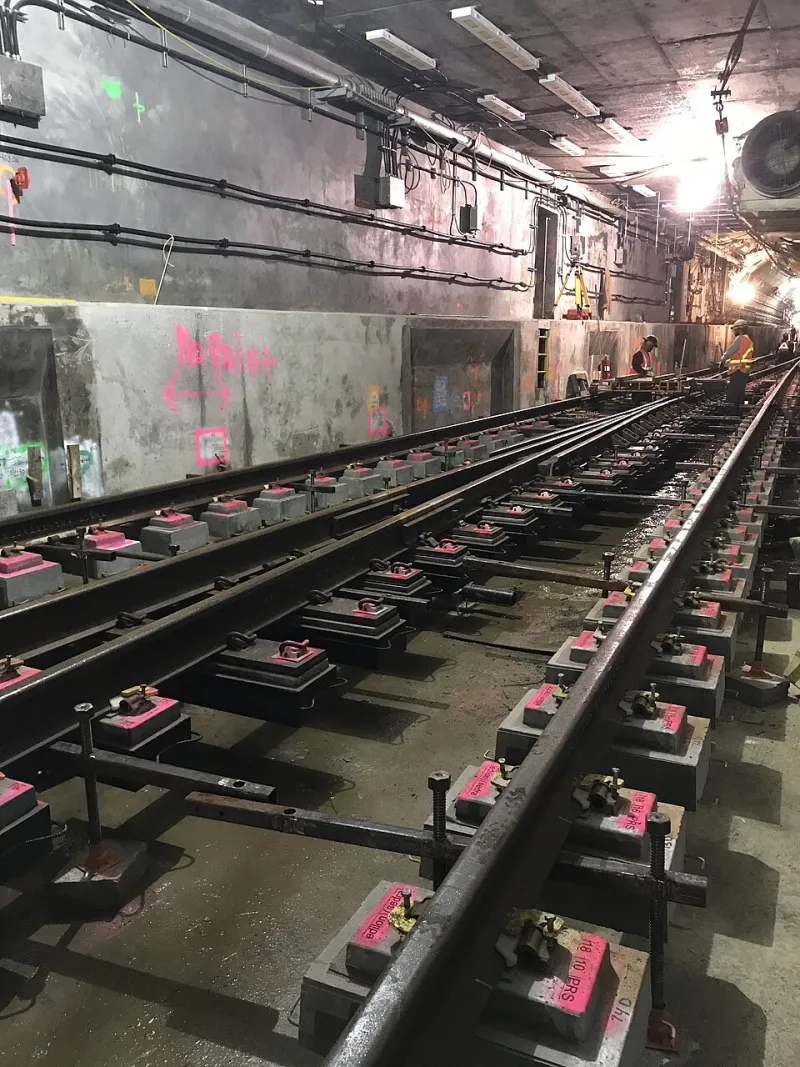
Photo: MTA Capital Construction Mega Projects, CC BY 2.0, via Wikimedia Commons
For every mile of ballastless track operating at 200 mph in Spain, Japan, or China, the United States has a handful of demonstration installations and a great deal of institutional skepticism. That skepticism is not ignorance. Class I engineering departments understand slab track well enough to reject it — and in most cases, they are right to. But the economics are shifting in ways that merit a fresh audit rather than a reflexive dismissal.
Why Ballast Still Wins the American Freight Case
Start with the fundamentals. Ballast is not a legacy compromise; it is a highly evolved engineering system for the specific demands of heavy-axle-load freight. American freight loading — up to 286,000 pounds distributed across four axles — imposes dynamic forces that European slab systems were never designed to absorb. Ballast distributes those loads, drains water, and, critically, allows maintenance gangs to restore geometry with ordinary equipment in ordinary work windows.
Slab track, by contrast, trades that adjustability for rigidity. When a slab moves — and over decades, everything moves — the correction involves grinding, grouting, or in the worst cases, replacing concrete in place. The maintenance burden does not disappear; it migrates from the ballast regulator to the concrete contractor, and the unit costs climb accordingly.
The freight railroads' resistance, then, is an asset allocation decision. Ballast spreads maintenance across a mature, competitive supplier ecosystem. Slab concentrates risk in long-lived, hard-to-modify civil works. For a railroad whose revenue depends on route availability across tens of thousands of miles, that concentration is difficult to justify.
Where the Math Starts to Bend
The exceptions matter, though. Slab track's lifecycle advantage appears where three conditions converge:
First, constrained maintenance access. In dense urban corridors, mountain passes, or shared-rights-of-way where work windows are scarce, the reduction in routine surfacing can be worth a premium. A track structure that needs 60 percent less periodic maintenance changes the possession calculus entirely.
Second, severe drainage or subgrade instability. Where ballast fouls rapidly — mud pumping, repeated washouts, frost-susceptible clays — the annual cost of fighting the subgrade can rival the amortized cost of a slab. Several transit agencies in the Northeast have reached exactly this conclusion on segments where ballast pockets refused to stay dry.
Third, long design life with stable alignment. Slab track rewards owners who will not move the track for a century. Tunnels, viaducts, and grade-separated approaches fit this profile. Fresh alignments subject to future reconfiguration do not.
American pilot experience supports a cautious middle position. Slab sections installed in transit systems in Los Angeles, Denver, and along parts of the Northeast Corridor have generally performed as designed — but they were passenger installations with lighter axle loads and disciplined maintenance regimes. Freight demonstration data remains thin, and the railroads know it.
What Would Change the Railroads' Minds
Three developments could move the needle. The first is domestic cost reduction. European slab systems carry premium pricing partly because specialized precast elements and installation trains must be imported. A mature American supply chain — precasters, slipform pavers adapted from highway practice, and contractors who have already built the skill base — could compress installed costs meaningfully.
The second is better substructure modeling. Slab track's greatest failure mode is settlement beneath a rigid layer. Advances in ground improvement and in-service monitoring are narrowing the uncertainty that makes engineers nervous about committing to concrete they cannot easily lift.
The third, and most plausible near-term driver, is the passenger-freight interface. As intercity passenger projects seek shared corridors, slab track may enter American practice through the passenger portions of those corridors — giving freight operators adjacent, observed performance data rather than theoretical arguments.
The Verdict for Now
Ballastless track is not coming to American freight as a wholesale replacement, and anyone promising otherwise is selling something. But the binary framing — ballast versus slab — obscures the real opportunity: selective deployment where drainage, access constraints, and alignment permanence align. On those miles, the concrete argument is genuinely worth having.
The railroads' loyalty to ballast is earned, not sentimental. Respect it, audit the exceptions honestly, and build the domestic capability now — so that when the right corridor arrives, the industry is ready to pour.