Quarry Math: The Aggregate Supply Chain That Decides Your Corridor's Budget
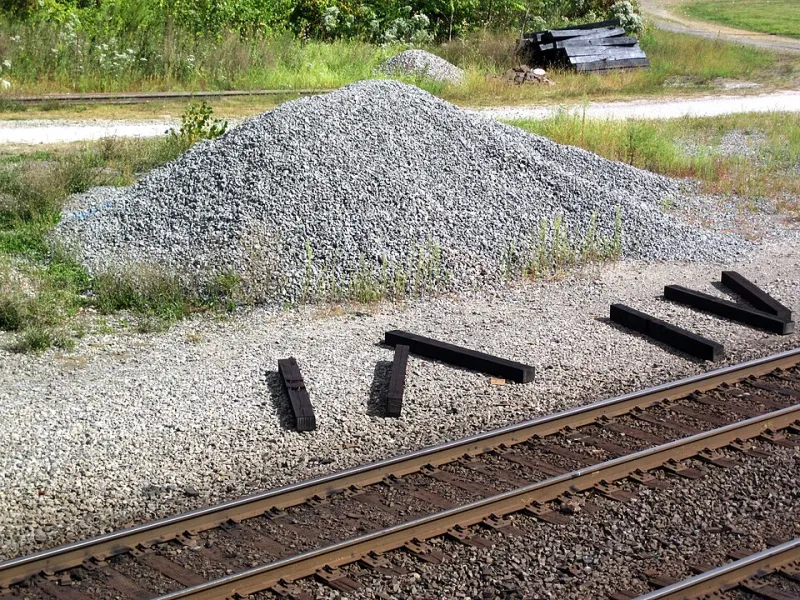
Photo: James St. John, CC BY 2.0, via Wikimedia Commons
Ask a room of rail planners what constrains a new passenger corridor and you will hear about right-of-way acquisition, grade crossings, rolling stock procurement, and environmental review. You will rarely hear about crushed stone. Yet on any greenfield alignment, ballast is measured in millions of tons, and every mile between quarry and track bed is paid for in diesel, driver hours, and schedule risk. The geology of a region, in other words, quietly writes a portion of the capital budget before a single survey stake is driven.
The Tonnage Nobody Talks About
A double-track main line consumes roughly 3,000 to 3,500 cubic yards of ballast per mile once proper shoulder geometry and depth are accounted for. At typical unit weights, that lands somewhere north of 5,000 tons per track-mile. A 200-mile corridor, a common scale for proposed intercity passenger projects, needs on the order of a million tons of ballast — moved once, on schedule, to a narrow linear corridor that cannot be serviced from every direction.
Compare that to a highway project, which draws aggregate from quarries scattered across a region and can stockpile along the alignment. Rail corridors concentrate demand in time and space. Construction trains run on the very track they are building, which means early segments must be ballasted before later segments can even receive material. The logistics chain has a critical path whether or not planners acknowledge it.
What Qualifies as Ballast — and What Doesn't
Not every quarry can serve the rail market. AREMA Chapter 1 specifications and the various Class I railroad standards that build on them demand crushed stone with high abrasion resistance, low clay and fine content, and angular fracture faces that interlock under load. In practice, that means hard igneous and metamorphic rock — granite, trap rock, basalt — or exceptionally durable limestone and dolomite from select formations.
Soft sedimentary stone that performs adequately under a farm road will degrade rapidly under 330,000-pound axle loads and repeated tamping cycles. Fines migrate, drainage collapses, and the section that was supposed to last decades needs undercutting in a handful of years. Procurement teams that accept the nearest quarry's product on faith are often buying a maintenance liability disguised as a bargain.
The Freight Equation
Ballast moves by rail or truck, and the economics diverge quickly. Trucking is flexible but expensive beyond roughly 30 to 50 miles of haul — the point at which transport cost begins to rival or exceed the delivered stone's value. Rail haul extends that economic radius dramatically, which is why major ballast producers like Martin Marietta, Vulcan, and Crushed Stone specialists maintain dedicated rail-served operations and why the AAR and stone industry associations track ballast as its own commodity flow.
But rail haul requires rail access, and that is where the circularity bites: building track to serve a distant quarry means mobilizing ballast from somewhere else first. Sophisticated contractors stage the problem, using existing interchange points, temporary storage sidings, and phased work trains to keep the tonnage flowing. Every additional handling adds cost and degradation — ballast that is loaded, unloaded, and stockpiled twice accumulates fines and broken edges that a specification inspector will eventually reject.
A Regional Reality Check
The United States is not uniformly blessed with rail-grade aggregate. New England and the mid-Atlantic states import significant crushed stone by ship and rail from quarries in Nova Scotia, Quebec, and the Hudson Valley because local glacial deposits are frequently gravel rather than competent crushed rock. Any serious Northeast Corridor expansion or restored inland passenger service in this region inherits a longer, costlier ballast supply chain by geography alone.
The upper Midwest sits atop some of the nation's premier trap rock and hard limestone, from Minnesota's granite country to Missouri's Ozark quarries — a genuine advantage for the Midwest passenger rail proposals now moving through state planning processes. Texas, by contrast, has abundant limestone but uneven distribution relative to the population triangle of Dallas, Houston, and San Antonio, meaning high-speed proposals there must map quarry capacity against alignment choice with the same rigor applied to station siting.
The Mountain West presents a different problem: excellent stone, sparse rail-served quarries, and long empty hauls that penalize any project needing material in a narrow construction window.
Procurement Implications
For agencies and their delivery partners, the practical lessons are straightforward. First, run the aggregate logistics study during alternatives analysis, not during final design — if one alignment sits 40 miles from a specification-compliant, rail-served quarry and another sits 8 miles from one, that difference belongs in the cost-benefit comparison alongside ridership and right-of-way figures.
Second, secure supply early. Aggregate production is capacity-constrained, and quarries serving a major corridor project will also be feeding concurrent highway and commercial work. Contracts that lock in tonnage, quality bands, and delivery windows protect both budget and schedule.
Third, write the specification to the corridor, not the checklist. A well-designed ballast section with disciplined compaction and drainage can sometimes justify a marginal local stone over a premium imported one — but only when the subgrade, drainage, and maintenance regime are engineered around that tradeoff deliberately.
Stone Before Steel
Rail projects generate their headlines from locomotives, stations, and speed figures. But the unglamorous million tons of crushed granite underneath is where budgets are quietly won or lost. Rail Construction Co. has seen corridors saved and corridors sunk by decisions made about stone before the first rail was ever ordered. Treat ballast logistics as infrastructure — because that is exactly what it is.