Off the Grid, On the Rails: Powering Wayside Systems Where the Wires Never Reached
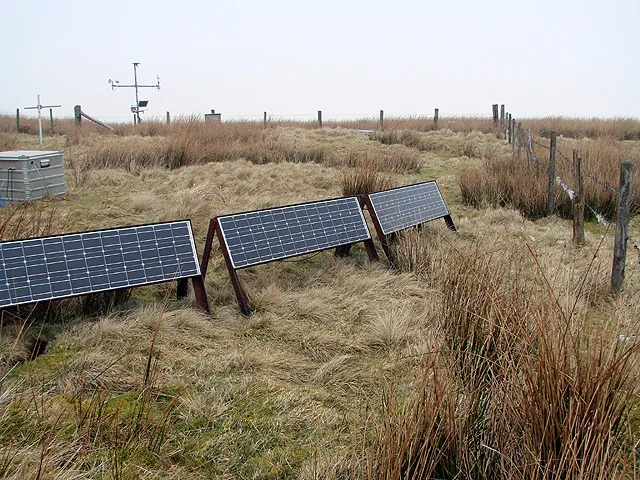
Photo: John Lucas , CC BY-SA 2.0, via Wikimedia Commons
Somewhere in the high desert of Nevada, a grade crossing warning system flashes its lights and drops its gates every time a train approaches — and it has never drawn a single watt from the utility grid. The same is true for switch heaters in the Montana Rockies, block signals across the Texas plains, and defect detectors along branch lines in the Dakotas. A quiet revolution in trackside power delivery has made the electrical service drop an optional luxury rather than a prerequisite for modern rail infrastructure.
For a construction and engineering firm, understanding this shift matters. The power design for wayside systems now influences alignment decisions, maintenance budgets, and the resilience posture of entire corridors.
Why So Much of the Network Was Never Wired
The American rail network is a patchwork of acquisitions, abandonments, and branch lines that were profitable precisely because they were cheap to operate. Utility extension is anything but cheap. When the cost of trenching distribution cable, securing easements across private land, and paying monthly service charges is amortized over a single crossing or a handful of switches, the numbers frequently fail. A utility drop that costs $75,000 to $150,000 to install — before the first monthly bill arrives — competes directly with a self-contained power package that can be installed in a day.
Historically, the gap was filled with primary batteries: large, heavy cells of lead-acid or nickel-iron chemistry that crews swapped on a scheduled cycle. It worked, but it was labor-intensive, logistically awkward, and environmentally messy. The modern alternative arrived only when photovoltaic panels became cheap enough and battery chemistry reliable enough to close the energy budget at the trackside.
The Anatomy of a Self-Sufficient Installation
A typical off-grid wayside power system follows a familiar architecture: a solar array sized against the worst month of the year, a battery bank engineered for days of autonomy, a charge controller, and — increasingly — a backup generator or fuel cell for redundancy.
The sizing exercise is where engineering discipline shows. Designers do not calculate against average sun; they calculate against the winter solstice, monsoon-season cloud cover, or the smoke-darkened skies of a fire year. In the northern tier, a crossing warning system must ride through a string of blizzard days on battery alone. Five to ten days of autonomy is a common design target, which is why battery capacity, not panel count, usually dominates the bill of materials.
Lithium iron phosphate has largely displaced lead-acid in new installations. The upfront premium is real, but the accounting favors lithium once cycle life, cold-weather performance, and the elimination of water-tolerance visits are factored in. For crews already stretched across hundreds of route-miles, every maintenance visit avoided is a vehicle-day recovered.
The Maintenance Economics, Honestly Stated
The industry's enthusiasm for solar wayside power deserves a sober audit. The tradeoffs are genuine.
The case for self-generation:
- Elimination of recurring utility bills and demand charges
- No trenching, no easement negotiations, no utility interconnection queues
- Immunity to regional grid failures — a lesson reinforced by Texas's 2021 freeze and successive hurricane seasons
- Faster deployment: a crossing can be powered before the concrete pad cures
The liabilities:
- Panel theft and vandalism, a chronic problem near urban corridors and highway overpasses
- Battery replacement cycles of eight to fifteen years, which must be programmed into lifecycle budgets rather than discovered
- Snow and dust accumulation that silently degrades generation until an alarm forces a visit
- A different failure mode entirely: when the system dies, it dies completely, and troubleshooting requires electrical competency that not every track gang carries
The economics break cleanly at a threshold. Where utility service exists within a few hundred feet, grid power usually wins. Beyond that line, self-generation dominates so thoroughly that many signal maintainers now specify it by default.
Extreme Weather Is Rewriting the Design Brief
The most consequential force in this market is not falling panel prices — it is the growing list of days when the grid itself cannot be trusted. Signal and communication systems that once treated commercial power as a given are now specified to survive multi-day outages. Railroads that watched hurricane seasons knock out crossing protection for a week at a stretch have begun treating wayside energy independence as a resilience investment, not a cost-cutting measure.
This has pushed hybrid designs into the mainstream. Solar-plus-battery remains the primary source, but a small propane generator or, in some installations, a fuel cell provides a second line of defense. The redundancy costs more on day one; it costs vastly less than a mainline derailment investigation triggered by a dark signal.
What It Means for Corridor Projects
For anyone planning new sidings, industrial leads, or crossing upgrades, the practical guidance is straightforward. Engage the power design early, because array placement competes for real estate with drainage, fencing, and sight lines. Budget battery replacement honestly across the asset's life rather than treating the installation as fit-and-forget. And where the corridor crosses remote terrain, treat energy autonomy as a design requirement from the outset — because in most of the places America's freight moves, the wires never showed up, and they are not coming.
The signal bunker in the desert does not need the grid. Increasingly, the grid needs it — as proof that the most reliable infrastructure is often the kind that answers to no one.