The Cheapest Derailment Is the One Water Never Causes: Why Drainage Deserves a Bigger Line Item
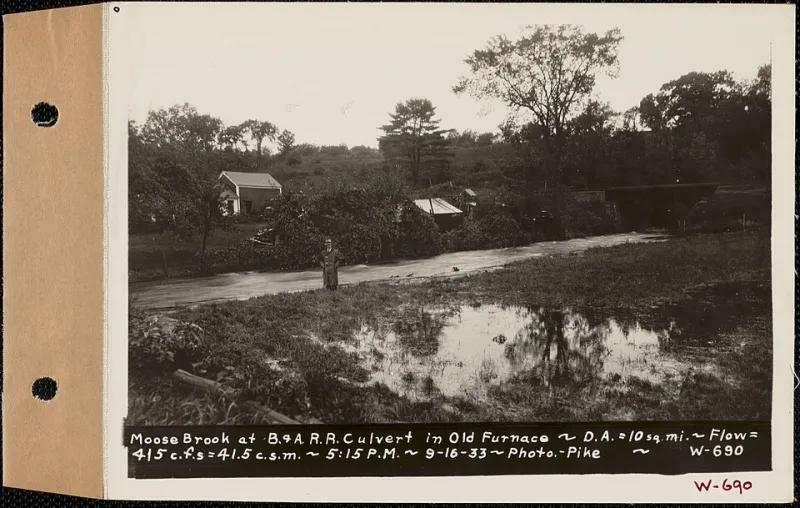
Photo: Massachusetts. Metropolitan District Water Supply Commission, Pike, Stuart D., 1910-1978, Pike, Stuart D., 1910-1978, Public domain, via Wikimedia Commons
When a freight corridor in the Missouri River basin lost three hundred feet of embankment to a spring flood two years ago, the repair invoice ran well into seven figures. The ballast was fine. The rail was fine. What failed was a culvert — undersized, half-silted, and thirty years past its design life — that turned a routine high-water event into a slow order, a service interruption, and a full embankment rebuild.
Nobody budgets for that culvert the way they budget for rail. And that, more than any single engineering failure, is why drainage remains the quiet profit center of American track construction.
The Line Item That Gets Value-Engineered First
On most rail construction estimates, water management sits near the bottom of the spreadsheet. Steel, ties, ballast, and earthwork dominate the numbers because they're visible, measurable, and easy to compare across bids. A ditch is a ditch. A culvert is a culvert. When a project runs over budget, drainage scope is the first thing trimmed — the cut rarely draws scrutiny until long after the ribbon-cutting.
The economics say otherwise. Industry studies and Class I maintenance records consistently point to water as the leading contributor to track substructure failures. Saturated subgrade loses shear strength. Fouled ballast holds moisture instead of shedding it. Pumping mud, settlements, and geometry degradation follow — and each one arrives as a slow order, a speed restriction, or eventually a derailment risk.
A corridor that drains well is a corridor that holds geometry. A corridor that holds geometry is a corridor that runs trains at speed without surprises. The connection between a $40,000 subdrainage installation and a $4 million avoided derailment is not always obvious on a bid tab, but it is unmistakable over a twenty-year asset life.
Anatomy of a Washout Recovery
The Missouri River basin rebuild mentioned above is instructive. The original culvert had been sized for a drainage area that decades of upstream development had substantially altered — more pavement, more runoff, more peak flow. Nobody had re-run the hydrology because nobody owned the culvert as an asset. It sat at the seam between a railroad's right-of-way and a county's road embankment, which in the American regulatory landscape often means it sat at the seam between two maintenance budgets and no maintenance plan.
The recovery itself was textbook: retainer walls, engineered fill, geotextile separation, a new double-barrel culvert sized to current hydrology. Total cost, including the traffic disruption absorbed by shippers, exceeded what a proactive replacement would have cost several times over — and that comparison excludes the near-miss. A train had crossed the site within an hour of the washout's discovery by a track inspector.
The lesson is not that washouts are unpredictable. The lesson is that the failure was legible years in advance to anyone who looked. Silt accumulation at the inlet. Rust-through on the pipe seams. Erosion scars downstream of the outfall. These are the tells, and they cost nothing to read during routine inspection.
What Good Drainage Construction Actually Looks Like
Drainage done right during new construction or major rebuild is not complicated, but it is disciplined:
- Hydrology first. Culvert sizing based on current watershed conditions, not 1950s surveys, with climate-adjusted peak flows for a design life measured in half-centuries.
- Ditch geometry as a specification, not a byproduct. Depth, side slopes, and gradient designed to move water away from the subgrade — and maintained as such, not as a blade-trim afterthought.
- Subdrainage where the soils demand it. Perforated pipe and filter aggregates under the ballast shoulder in cut sections and known wet spots, installed while the machines are already there.
- Outfall ownership. Every pipe discharges somewhere. Confirming that the discharge point is stable, permitted, and somebody's responsibility prevents the most common slow-motion failure in the industry.
None of this is exotic. All of it is cheaper at construction than at reconstruction.
Reading a Bid Like a Hydrologist
For public-sector and industrial clients evaluating rail construction proposals, the drainage line is a diagnostic. A bid that prices ditches and culverts at a fraction of competitors' figures is not necessarily efficient — it may simply be deferring your cost into your maintenance budget. Ask three questions: Is the culvert sizing based on current watershed analysis? Is subdrainage scoped in wet subgrade areas or value-engineered out? Who maintains the outfalls after substantial completion?
A contractor who can answer those questions with specifics is a contractor who has built corridors before and watched them age. The cheapest derailment is the one water never gets the chance to cause — and preventing it starts on the bid tab, not the flood stage gauge.