Neutral Temperature Is a Decision: Auditing Continuous Welded Rail for the Next Heat Season
Photo: A.Savin, FAL, via Wikimedia Commons
Continuous welded rail does not fail on a schedule. It fails when the thermal budget it was built around no longer matches the temperatures it actually sees. For track owners preparing 2027 operating plans, the useful question is not whether a heat restriction will be imposed, but whether the corridor has the neutral temperature, fastener condition, and ballast profile to keep restrictions rare, short, and defensible.
The Ledger Starts With Neutral Temperature
Rail neutral temperature, or RNT, is the temperature at which the rail is stress-free in the track structure. It is set during installation, adjusted during destressing, and then slowly compromised by tie behavior, fastener slip, surfacing, and traffic. An RNT of 90 degrees Fahrenheit on a corridor that reaches 135 degrees Fahrenheit in July is not a moral failure; it is a design assumption that has to be audited against actual conditions. The audit begins with a representative sample of rail temperatures, not a single reading at noon. Track owners should require calibrated rail-temperature measurement, documented RNT history, and a comparison of design assumptions with the last three summers of operating restrictions.
Thermal Force Is a Budget Line
The mechanics are straightforward. Steel expands when heated. When that expansion is restrained, the rail develops compressive force. The approximate stress is the product of Young's modulus, the coefficient of thermal expansion, and the temperature differential. For a 50-degree Fahrenheit rise above neutral, the stress is roughly 9,400 psi. In 136RE rail, that is on the order of 120,000 pounds of compressive force, or about 60 tons, stored in a single rail string. That force does not disappear because the dispatcher lowers train speed. It is redistributed into ties, fasteners, ballast, and the lateral resistance of the track panel.
This is why heat restrictions are an economic instrument as much as a safety one. A slow order that adds ten minutes to a train may look modest on a single movement. Multiplied across a busy subdivision for several weeks, it becomes a capacity and crew-cost problem. The ledger should show both sides: the cost of destressing and surfacing work, and the cost of the restrictions that work is meant to prevent.
Reading the Corridor: Where Heat Restrictions Really Come From
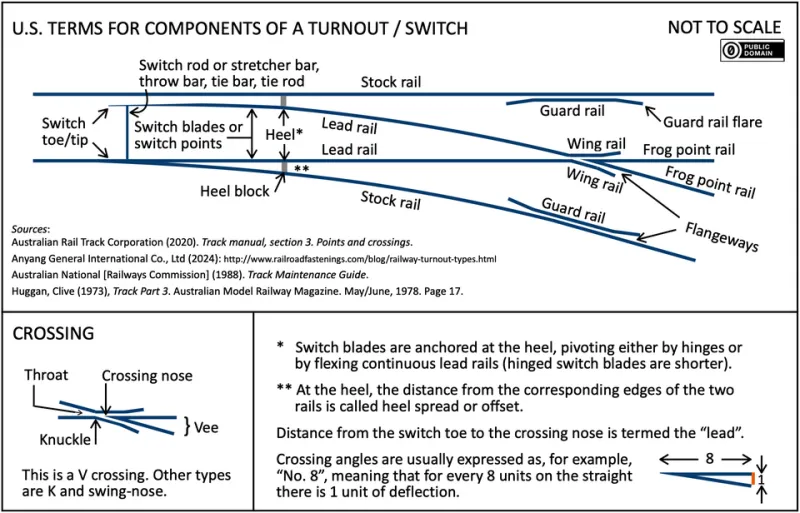
Heat kinks rarely appear in the middle of a perfect track panel. They concentrate where lateral resistance is low: at curves, near turnouts, at bridge approaches, in recently surfaced areas, and where ballast is fouled or the shoulder is insufficient. A corridor audit should map those locations before summer. Inspectors should look for missing crib ballast, pumping ties, wide gauge, rail seat abrasion, and fastener toe load that no longer matches specification.
The audit also needs a records layer. What was the as-installed RNT? When was the last destress? Were there cut-in welds after a defect repair? Has the track been surfaced since? A corridor with strong records can target work. A corridor without them has to buy certainty through sampling and conservative restrictions.
Destressing, Surfacing, and the Specification That Holds
Destressing is not a generic remedy. It is a controlled operation: cut or anchor the rail, heat or tension it to a target temperature, weld or fasten it, and then verify the result. The specification should state the target RNT range, the measurement method, the allowable variation between strings, and the acceptance documentation. It should also address the interaction with surfacing. Lifting and tamping can change the stress state, so sequencing matters. On many programs, the defensible sequence is to complete ballast and tie work first, then destress, then verify profile and lateral resistance.
Surfacing alone is not a substitute for stress management. It can restore geometry and improve lateral resistance, but it does not remove compressive force from a rail string that was installed at the wrong neutral temperature. Owners should require a joint plan that ties surfacing, ballast maintenance, and destressing to the same thermal objective.
Building a Defensible Heat-Response Plan
A heat-response plan should be written before the first hot week, not negotiated during it. It should define temperature thresholds, inspection frequency, speed restrictions by track class and location, communication protocols, and the trigger for emergency work. It should identify the accountable engineering lead and the data source for rail temperature. It should also include a post-season review that compares predicted risk with actual restrictions.
For government and industrial owners, the strongest plan is one that can survive a budget hearing. That means documenting the work, the cost, and the avoided restriction hours. The plan does not need to promise zero heat restrictions. It needs to show that the corridor is managed against a known thermal budget, that the highest-risk locations are addressed first, and that the next summer's schedule is set with eyes open. In a hotter operating envelope, neutral temperature is not a background detail. It is a decision that belongs in the capital plan.