Reading the Rails Before They Read You: Building a Rebuild Trigger That Works for Your Track
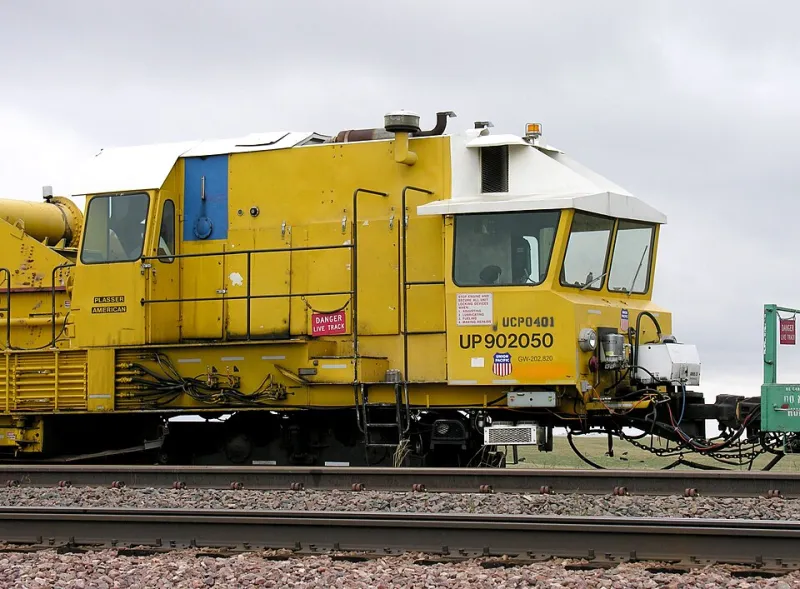
Photo: Greg Goebel from Loveland CO, USA, CC BY-SA 2.0, via Wikimedia Commons
Somewhere in Fort Worth and Omaha right now, analysts are watching MGT counters climb. Million gross tons — the accumulated weight a segment of rail has carried — is the quiet clock behind nearly every major track investment decision in North America. Class I railroads don't wait for a derailment or a slow order to justify a rebuild. They know, within a reasonable band, when a segment has consumed its useful life, and they budget accordingly.
If you own or manage industrial trackage — a plant spur, a warehouse lead, a short line serving three shippers — you can run the same discipline on a spreadsheet. Doing so turns track maintenance from an emergency expense into a scheduled capital line item.
Why Tonnage, Not Time, Drives Track Life
The intuitive approach to asset management is calendar-based: inspect every year, replace every twenty. Rail doesn't obey calendars. A branch line moving two cars a week can sit in decent condition for decades. A unit-train loader pushing 30 MGT annually can wear out rail in eight.
Gross tonnage is the better denominator because nearly every degradation mechanism — rail head wear, fatigue cracking, ballast fouling, tie plate cutting — scales with accumulated load. Federal Railroad Administration track classes and most railroad engineering standards are written around it. When you know your annual tonnage, you know your clock speed.
Start by getting a real number. Your railroad's car movement reports, your demurrage records, or a simple tally of outbound loads times 143 tons per car (plus locomotive weight) will get you close. Multiply by annual volume, and you have the MGT figure that everything else hangs on.
The Condition Signals That Matter
Tonnage is the clock; condition data is the alarm. A practical monitoring program for private track doesn't need to be elaborate, but it does need to be consistent. Four indicators carry most of the signal:
Geometry degradation rate. A single deviation is noise. A curve that needed a 10 mph restriction last year and needs one again this spring is a trend. Track geometry degrades at a rate proportional to tonnage and substructure quality — measure it the same way each cycle.
Rail wear and defect density. Internal rail defects found by hand or Sperry-type testing, plus visible head wear at the gauge face, are leading indicators. When defect density in a segment starts climbing year over year, the rail's fatigue life is being spent faster than it's being replaced.
Tie and fastener counts. Walk a representative sample — 300 feet per mile is a common approach — and count defective ties, cracked plates, and spike pulls. When the defective percentage crosses roughly 20–25%, surfacing stops buying you meaningful life.
Ballast fouling. Clean ballast drains; fouled ballast pumps mud into your geometry. A hand level, a few representative digs, and an honest assessment of whether the surfacing cycle is shrinking tell you when ballast — not rail — is your limiting asset.
Building Your Own Trigger Criteria
The Class I approach is essentially a decision table: if tonnage exceeds X and condition Y crosses threshold Z, action A is funded. You can build a simplified version in an afternoon.
Step one: identify the limiting asset. For each segment, determine what will fail first — rail, ties, ballast, or the subgrade itself. On a low-tonnage industrial spur, ties and ballast usually fail long before rail does. On a heavy unit-train lead, it may be the reverse.
Step two: set thresholds in advance. Decide now, while calm, what triggers a full rebuild versus a surfacing cycle: defect counts, geometry exceedances per mile, tie percentage, years since last surfacing. Writing the thresholds down before the data gets bad is what separates planning from rationalization.
Step three: attach dollar figures. A full rebuild of industrial track typically runs $250 to $600 per foot depending on region and materials; surfacing might be a tenth of that. When your trigger fires, you want the number already in the capital plan — not discovered during an emergency quote.
Step four: schedule the inspection cadence to your tonnage. A 1 MGT spur might justify a thorough annual walk. A 10 MGT lead deserves semi-annual geometry attention. Match the inspection frequency to the clock speed, not to whatever the last incident forced.
The Cost of Reacting Instead
The economics here are unforgiving. Emergency track work carries a premium — mobilization, expedited materials, service disruption to your plant, and in the worst cases, a derailment that brings regulatory attention and environmental cleanup. Industry experience consistently shows that planned rebuilds executed during scheduled windows cost a fraction of reactive ones.
There's also the negotiation angle. If you serve a connection railroad, demonstrating a documented maintenance plan with tonnage-based triggers strengthens your position in interchange discussions and insurance reviews. It signals that your track — which their crews and their freight will operate over — is managed, not hoped over.
Start With the Counters You Already Have
You don't need wayside wheel-load detectors to begin. You need annual tonnage, a consistent inspection record, pre-written thresholds, and the willingness to fund the trigger when it fires. The railroads that built this country's freight network didn't get it right by waiting for the rails to tell them — they counted, they measured, and they planned.
Your track deserves the same discipline, at whatever scale your tonnage demands.