Midnight Steel: The Real Price Tag of Working Between Trains
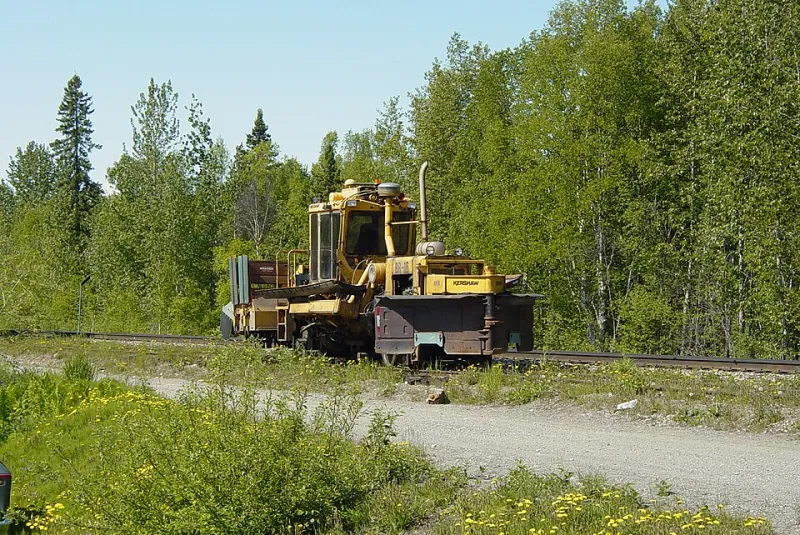
Photo: Bob Keefer, CC BY 2.0, via Wikimedia Commons
There is a particular kind of arithmetic that only exists on a freight railroad at two in the morning. A crew that laid three switch panels per hour under the sun might manage two under portable light towers. The labor costs more, the equipment idles more, the inspector squints more — and yet, for a growing share of American track projects, this is the only version of the work that gets approved.
Understanding why requires looking past the hourly rate and at the system the night shift exists to protect: the supply chain of the customer, not the convenience of the contractor.
Why the Window Is Four Hours, Not Four Days
On an active mainline, track time is issued by the railroad's dispatching and engineering departments in carefully rationed blocks — often two to six hours, frequently between midnight and 5 a.m., when traffic density bottoms out. These windows are not arbitrary. A typical subdivision may move forty or more trains a day, and every minute of possession ripples outward: crews die on sidings, interchanges back up, and the railroad owes shippers performance credits.
The result is a construction economy inverted from nearly every other infrastructure sector. Highway contractors get lane closures measured in weeks. Rail contractors get possessions measured in hours, and the clock starts the moment the track is officially granted — not when the first machine rolls in.
Deconstructing the Night Premium
Ask any estimator who has bid a nocturnal possession and the premium breaks into recognizable layers:
Labor differentials. Night work under most collective bargaining agreements carries shift differentials, and the pool of qualified track workers willing to run tampers and cranes between midnight and dawn is thinner than the daytime roster. Scarcity prices itself.
Lighting and power. A work zone that needs no illumination at noon needs a small temporary power plant at 2 a.m. Light towers, generators, fuel, and the maintenance labor to keep them running add real dollars per production hour — and poor lighting slows every task from bolt torquing to weld inspection.
Fatigue and supervision. Human factors research is unambiguous: error rates climb overnight. Contractors respond with additional supervision, mandatory rest protocols, and scheduling that effectively shortens the productive shift. Safety is non-negotiable; the cost of engineering for it lands in the bid.
Mobilization compression. When the window closes, the track must be open — fully, FRA-compliantly open. That means every machine, every crew, and every contingency plan is built around a hard deadline with no overtime cushion. Contractors often stage redundant equipment on site simply to insure against a single hydraulic failure at 3:30 a.m.
Stack these together and the 20-40% premium over equivalent daylight production is not padding. It is the honest cost of buying speed with inconvenience.
The Framework Shippers Should Actually Use
For a railcar-loading customer — a grain elevator, a plastics plant, an aggregate operation — the question is rarely "is night construction expensive?" It is "expensive compared to what?" We recommend a three-column comparison:
Column one: the premium. The added cost of nocturnal possession, typically quoted per production hour or per project.
Column two: the interruption cost. What a daytime or multi-day closure actually costs the operation. For a facility shipping sixty cars a week, a missed switching cycle can mean demurrage, diverted trucking, or production shutdowns. A single week of trucking a high-volume commodity can erase a night premium several times over.
Column three: the risk carry. Daytime work on live track means slower production, more partial-occupancy flagging, and a longer exposure window for something to go wrong. Compressing the work into a clean overnight possession is, counterintuitively, often the lower-risk path.
In most cases where the shipper has meaningful daily volume, column two dwarfs column one. That is the quiet logic behind why shippers themselves petition railroads for night windows rather than resist them.
Restructuring the Bid Around the Clock
Experienced contractors have adapted their estimating to this reality. Production rates are indexed by window length, not calendar day. Crews are cross-trained so a single possession can absorb a stalled task without stalling the job. Materials — rail, ties, turnouts — are pre-assembled adjacent to the work zone so the four hours are spent installing, not fetching.
The best bids also price the risk of the window itself: what happens if the dispatching desk cancels at midnight because of a hot bearing two subdivisions away? Contingency language and remobilization clauses are not fine print; they are the difference between a contractor who returns for the next window and one who cannot afford to.
Paying for Certainty
Night track work is, at its core, a premium product: the customer is buying the railroad's most valuable asset — uninterrupted service — by paying for labor at its least efficient hours. For public agencies and industrial shippers alike, the lesson is to stop evaluating night construction as an inflated version of day construction, and start evaluating it as what it is: an insurance policy written against the full cost of a shutdown.
On the balance sheet of a functioning supply chain, that policy is usually a bargain.