The Fork in the Track: Inside the Machine That Moves a Million Cars a Day
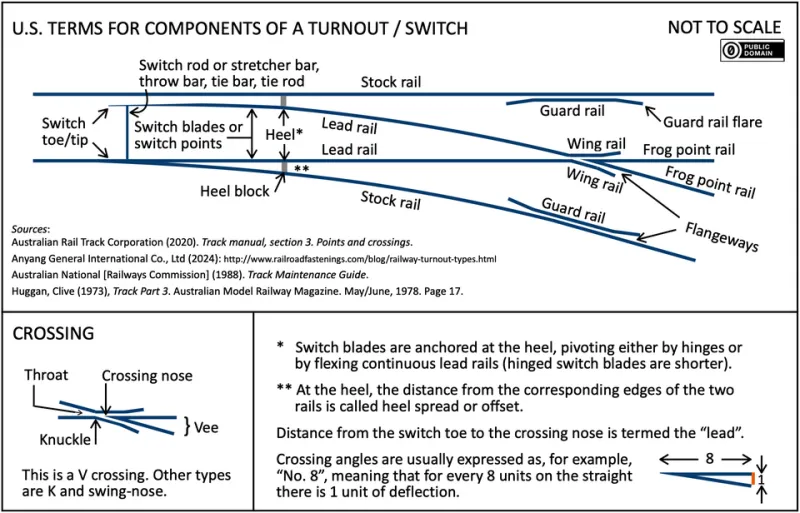
Photo: SCHolar44, CC0, via Wikimedia Commons
Ask most people what keeps a freight railroad moving and they'll point to the locomotive. Ask anyone who has actually maintained a busy subdivision and they'll point somewhere quieter: the turnout. Every day, hundreds of thousands of railcars change direction across the American network without slowing down, and nearly every one of those movements passes through a switch — a precision machine of rails, frogs, and moving points that most of the public never notices and many budgets chronically underestimate.
What a Turnout Actually Is
A turnout is not a single component but an assembly: switch points that flex the route, a frog that lets wheel flanges cross intersecting rails, closure rails that tie the two together, and a long trail of tie plates, braces, and fasteners that hold the geometry true. Turnouts are described by number — a No. 8, a No. 11, a No. 20 — and that number is essentially a statement about geometry. The higher the number, the longer and gentler the divergence, and the faster a train can take it.
That choice is an economic decision as much as an engineering one. A high-numbered turnout in an intermodal terminal lets double-stack trains move through at track speed, but it consumes hundreds of feet of real estate and more material. A low-numbered switch in an industrial lead is compact and cheap, but it caps movement speed and concentrates wear. Every siding design starts with this trade-off.
Where the Money Leaks
Turnouts earn their reputation as maintenance hot spots for a simple reason: they concentrate dynamic forces. Diverging moves subject the points and stock rails to lateral impact. The frog absorbs the hardest blows on the railroad, as wheels drop across the flangeway gap thousands of times a day. Every component in the assembly wears faster than the plain track around it — and wears non-uniformly, which is the part that destroys budgets.
The chronic failure pattern is familiar to any track supervisor. First, the switch points begin to lose their fit against the stock rails. Then the frog develops batter at its corners. Surface geometry starts to need attention every few months instead of every few years. Surfacing cycles compress, tamping crews return again and again, and before long the switch that was supposed to serve for two decades has consumed its replacement cost in maintenance labor.
The cheapest turnout, in other words, is almost never the one with the lowest bid. It's the one designed with the right frog type, the right rail section, and the right hardware for the tonnage and speed it will actually see.
Fabrication Tolerances You Can't Fix in the Field
A modern turnout is largely built in a shop, not on the right-of-way. Frogs and switch points are machined to tolerances measured in thousandths of an inch, and preassembled panels arrive at the job site with the geometry already locked in. That factory precision matters because there is no such thing as adjusting a frog in the field. If the flangeway is wrong at installation, it stays wrong until the assembly is replaced.
This is why we treat turnout procurement as an engineering deliverable, not a purchasing line item. The specifications that matter — point length, heel block configuration, frog type, plate design, fastening system — have to be resolved against the actual service conditions before fabrication begins, not discovered during commissioning.
Installation Is a Sequencing Problem
Even a perfectly fabricated turnout can be ruined by a careless installation. The work typically happens in a compressed possession window — often a weekend — and the sequence is unforgiving: remove the existing track, excavate and replace fouled ballast, set the panels, then surface and line the entire diverging route, including the exit track beyond the frog, which is where inexperienced crews most often stop short.
The details that determine long-term performance are the unglamorous ones. Fresh, clean ballast under the full footprint of the assembly. Proper tamping of every crib, including the tight quarters around the frog. Correct switch stand and connecting rod adjustment so the points close fully against the stock rail under traffic. A turnout that is surfaced perfectly through the body but left rough on the leaving end will pound itself out of geometry within a year.
The Lifecycle Math
For a private track owner or an industrial developer weighing a rail investment, the turnout deserves its own line in the pro forma — and its own line in the maintenance budget. A switch serving a busy chemical terminal lives a very different life than one on a once-a-week grain lead, and it should be specified, installed, and inspected accordingly. Ultrasonic testing of the frog, geometry measurement at the points, and a disciplined record of surfacing intervals will tell you years in advance whether an assembly is aging gracefully or heading toward failure.
The railroad switch may never get the respect of the locomotive or the drama of the bridge. But route a single train through a well-built, well-maintained turnout at speed, and you're watching one of the most underappreciated machines in American industry do exactly what it was engineered to do — for decades, one car at a time.