The Economics Beneath the Rails: How Substructure Engineering Determines Freight Profitability
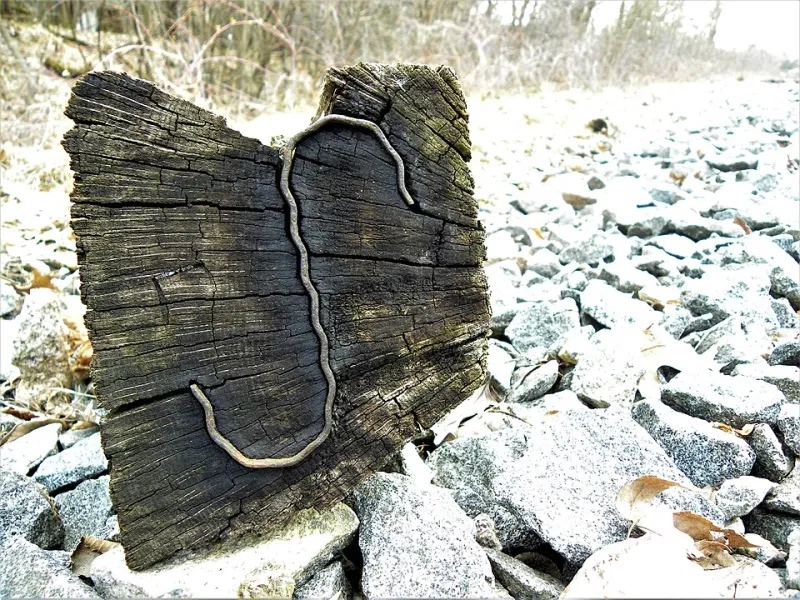
Photo: Mathieu Landretti, CC BY-SA 4.0, via Wikimedia Commons
Every freight railroad executive can quote the price of a locomotive or a mile of new rail. Far fewer can quantify the cost of a poorly engineered track bed — yet that cost compounds silently for decades, surfacing as slow orders, emergency surfacing crews, and premature ballast replacement.
At Rail Construction Co., we have seen the pattern repeatedly: two corridors built in the same era, carrying similar tonnage, diverge sharply in maintenance intensity. The difference is almost never the rail itself. It is what lies beneath it.
The Subgrade Is the Foundation of the Balance Sheet
Subgrade failure is the root cause behind a majority of track geometry defects. When fine-grained soils beneath the ballast section saturate and pump under cyclic loading, the result is fouled ballast, differential settlement, and geometry cars flagging exceptions at every run.
For a Class I operator, a single slow order across a busy subdivision can cost tens of thousands of dollars per day in lost capacity and velocity. Multiply that across a season of wet-weather pumping on a clay-heavy subgrade, and the arithmetic favors over-building the foundation from the start.
Key subgrade investments that pay measurable dividends include:
- Lime or cement stabilization of expansive soils in high-plasticity zones
- Geosynthetic separation layers to prevent fines migration into ballast
- Subballast thickness optimization matched to projected axle loads and traffic density
Ballast Composition: A Procurement Decision With a 30-Year Tail
Ballast is frequently treated as a commodity purchase. It should not be. Angularity, abrasion resistance (LA Abrasion and gradation per AREMA Chapter 1), and petrography all determine how quickly the stone degrades into fouling material.
A crushed granite or trap rock ballast with high fracture faces resists rounding and maintains drainage far longer than a marginal limestone. The upfront premium — often modest on a per-mile basis — delays tamping cycles, extends undercutting intervals, and reduces the frequency of full-ballast renewal. On a 100-mile corridor, the difference in renewal timing can shift a nine-figure capital event by a decade.
Drainage: The Cheapest Insurance in Railroading
Water is the primary agent of track bed failure. A track that sheds water effectively can carry traffic on a marginal subgrade; a track that ponds water will fail even on excellent stone.
Ditch depth, cross-slope, subdrainage, and culvert condition should be engineered as a system, not patched reactively. In our project experience across the Midwest and Southeast, corridors where drainage was designed to handle the 25-year storm event consistently show lower annual maintenance-of-way spend and fewer weather-related speed restrictions than peer lines.
Lifecycle Economics: Running the Numbers
Decision-makers evaluating track construction bids should normalize proposals on a cost-per-ton-of-hauled-freight basis over a 30-year horizon, not a first-cost basis. A representative comparison:
| Investment | First-Cost Premium | Typical Lifecycle Benefit |
|---|---|---|
| Subgrade stabilization | 3–6% of corridor cost | Reduced surfacing frequency; fewer slow orders |
| Premium ballast spec | 5–10% of ballast cost | Extended renewal cycle by 8–12 years |
| Engineered drainage system | 2–4% of corridor cost | Lower weather-related delay costs |
Public agencies and industrial sidetrack owners who adopt this lens routinely find that the lowest-bid construction option is the most expensive one over the asset's life.
A Case in Point
On a recent heavy-haul industrial lead serving a Gulf Coast intermodal facility, the owner elected to stabilize a two-mile soft-soil section and install geogrid reinforcement rather than accept routine periodic surfacing. Five years in, the corridor has required no geometry-related speed restrictions, while an adjacent legacy line of comparable tonnage has logged multiple slow orders and two emergency surfacing mobilizations. The stabilization premium was recovered — in avoided delay costs alone — inside the first three years.
The Takeaway for Decision-Makers
Track bed engineering is not a line item; it is the operating margin of the route. Whether you are a state DOT programming freight rail funds, a port authority building on-dock capacity, or an industrial shipper constructing a unit-train facility, insist on lifecycle-based design from your construction partners.
The most profitable miles of railroad in America are the ones nobody has to think about. That silence is engineered.