Building for Heavier, Faster, Smarter: Five Construction Advances Reshaping American Rail Capacity
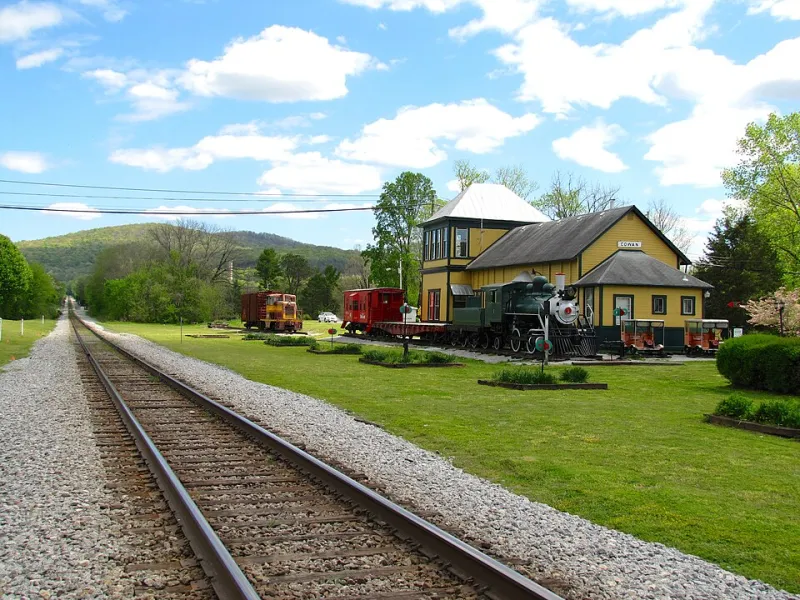
Photo: Brian Stansberry, CC BY 3.0, via Wikimedia Commons
American freight demand is trending in one direction: up. Port volumes, intermodal conversion, and the onshoring of manufacturing are pushing railroads and their public-sector partners toward corridors that can handle heavier axle loads, longer trains, and tighter schedules.
Meeting that demand is not simply a matter of laying more track. It requires construction methods that deliver higher precision, faster installation, and longer service life. Five advances in particular are changing how new capacity gets built in the United States.
1. Continuous Welded Rail Installation at Scale
Jointed rail is a relic on any corridor with serious tonnage ambitions. Continuous welded rail (CWR) eliminates the joint gaps that accelerate component wear and create ride-quality and maintenance headaches under heavy axle loads.
Modern CWR logistics — specialized trains carrying 1,500-foot rail strings, field welding with precise thermite or flash-butt processes, and engineered de-stressing for temperature ranges that can swing 100 degrees Fahrenheit in a single week — allow new construction to achieve mainline quality from day one.
The capacity benefit: CWR corridors support higher allowable speeds, reduced surfacing cycles, and the load spectra associated with 286,000-pound and next-generation 315,000-pound car standards.
2. Automated and Semi-Automated Track-Laying Equipment
Track-laying systems that place panels, fasten, and roughly line track in a continuous operation have compressed construction timelines dramatically compared to traditional gang methods.
For planners, the significance is schedule certainty. A project that once required a season of track time can be delivered in weeks of productive work, which matters enormously when construction windows must avoid disrupting revenue service on adjacent tracks — a constant reality at port terminals and on shared corridors.
The capacity benefit: Shorter possession windows, lower labor exposure, and the ability to deliver new capacity ahead of peak shipping seasons.
3. Precision Surveying and Machine Control
Three-dimensional survey control — combining GNSS, total stations, and laser-guided machine control on graders and tampers — has moved track construction from art toward science. Sub-inch positional accuracy across a curve or a grade crossing is now achievable and verifiable.
This precision matters downstream. Track built to tight geometric tolerance requires less initial tamping, holds geometry longer under traffic, and produces cleaner as-built data for future maintenance planning and PTC integration.
The capacity benefit: Faster track certification, fewer early-life geometry exceptions, and smoother handoff to operations.
4. Advanced Earthwork and Substructure Technologies
The techniques described in our lifecycle economics coverage — soil stabilization, geosynthetics, engineered drainage — are increasingly standard specification on new intermodal terminals and passing sidings rather than value-engineering casualties.
For port authority and state freight-planning clients, specifying substructure quality up front is the single most effective lever for ensuring a new corridor performs under the traffic volumes that justified its construction.
The capacity benefit: Infrastructure that sustains design tonnage without early degradation or speed restrictions.
5. Modular and Prefabricated Construction Methods
Grade crossings, turnouts, and even short panel tracks are increasingly assembled off-site as modular units and installed during brief windows. A pre-assembled turnout set in one shift replaces a multi-day in-track build.
In dense terminal environments — Chicago, Fort Worth, the Southeast ports — this approach minimizes disruption to live operations while accelerating overall project delivery.
The capacity benefit: Terminal modifications executed without extended service interruptions, keeping existing freight flowing while new capacity is added.
What Planners Should Do Next
For agencies programming freight rail funds and shippers developing new facilities, the construction method is not a contractor detail — it is a capacity and resilience decision. Specifications should call out CWR, modern survey tolerances, and substructure performance standards explicitly, and bid evaluation should weigh delivery schedule and lifecycle performance, not first cost alone.
America's supply chain resilience will be built one corridor at a time. The projects that matter will be the ones built with methods equal to the freight they must carry.